This report covers the recent Council meeting chaired by Mayor Debbie Whitworth and held on the September 2026.
The session addressed critical shifts in regional development, local infrastructure challenges, traffic management, community milestones, and administrative governance.
Richard Freeman was the first to speak.
Richard said that Olney Town Council approached residents to become involved with the Recreational Committee. However, after attending multiple meetings, there is a great sense of frustration. Frustration that there are no opportunities for genuine face-to-face dialogue, and that we cannot contribute fully to discussions, challenge assumptions, or add value through direct engagement. There is also frustration around the continued lack of clear direction, which leaves us unclear about what the council wants us to do as a group. At times, it feels like the group is little more than a tick-box exercise, with individuals wanting us not to succeed but rather to return to the status quo. From a resident’s perspective, there appears to be a reluctance to commit to some of the more difficult decisions needed to address the root causes of these issues. These important decisions continue to be deferred, positive proposals and questions are pushed into future meetings, and many recommendations remain under consideration rather than being delivered.
What concerns him is that, despite all the meetings, discussions, and reports, it’s still difficult to identify what has fundamentally changed since May. Residents are still waiting for Olney Town Council to produce a coordinated strategy that tackles the underlying causes of anti-social behaviour, disorder, parking pressures and public safety concerns. Olney Town Council have authorised the replacement of the old bins, new road markings, and signage banners, etc. These are all welcome improvements, but they do not, on their own, address the behaviours that caused concern in the first place. There has also been concern that the focus has shifted towards managing the group rather than solving the underlying problems.
Residents are entitled to ask what has actually changed. One of the biggest frustrations has been a lack of information and transparency. The working group has spent weeks requesting information about Spartan Security, its role, reporting arrangements and how its performance is measured. It has only now come to light that, apparently, no formal contract is in place.
If that is the case, then serious questions arise. Why were OTC and the group not informed when those questions were first raised in May? If invoices have been received and authorised for payment, residents are entitled to understand what service is being delivered. There is also growing frustration that the communication with partner agencies is becoming increasingly restricted.
No one is suggesting that the agencies should be overwhelmed with requests. However, effective partnership working depends on open dialogue, face-to-face engagement, and information sharing. The Phonebox, local residents, and people such as David Pibworth show willingness to support action and communicate good news when progress is made.
The difficulty is that there are very few significant positives or progress to report, only token gestures. Residents are not looking for more reports, more reviews, or more deferred decisions. They are looking for leadership, action, communication, and a clear plan that delivers measurable results, something which is lacking from the top of Olney Town Council’s management at the moment.
Francis Gander
After formally thanking the previous speaker, the Mayor welcomed Francis Gander to the floor on behalf of the Recreation Working Group. Francis commended the team’s internal communication and positive public feedback, but sharply criticised Olney Town Council for its lack of outward transparency and an apparent embargo on requested information. Invoking the Nolan Principles of public office, specifically openness and accountability, Francis challenged the council’s procedural handling of the group’s terms of reference and its ‘tokenism’ in denying resident members a voice during key discussions. While welcoming the Town Clerk’s agreement to a forthcoming public meeting to finally share the group’s hidden proposals, Francis concluded with a cautionary note on the power of language, praising a recent local news report for its accuracy while warning that selective wording can easily create bias over truth.
Kevin Viney
Kevin Viney was the third speaker and wished to raise the draft minutes of the Recreation & Services Committee meeting held on 26th August. Specifically, he drew attention to the phrase recorded under the working group’s remit, stating that it ‘does not include badgering the police on matters beyond the rec’.
He objected to including the word ‘badgering’ in the formal record. At no point during the meeting did the Chair, the Town Clerk, or any member present use this word. The official audio recording of the meeting will confirm that this language was never used.
He added that minutes must be a fair, objective, and accurate record of what was actually said. The word ‘badgering’ introduces a damaging implication of inappropriate conduct toward Thames Valley Police. Its inclusion casts an unfair light on local volunteers and misrepresents the tone of the discussion.
He formally requested, therefore, that the word ‘badgering’ – and the misleading impression it creates – be removed from the draft, and replaced with a factual summary of what was actually agreed, before these minutes are proposed for approval.
Jim Cooper
Declining to step to the front of the chamber due to a lack of time, which sparked some amusement in the room, Jim Cooper was next to speak and addressed the council regarding an important piece of correspondence received from Milton Keynes City Council. He highlighted an active enforcement notice (ENF 20260274) issued against the unauthorised crane depot land on the north-west side of Warrington Road. Jim strongly criticised the town council for failing to seize a ‘golden opportunity’ to back the county authority, warning that silence from local leaders would signal apathy to Milton Keynes City Council. Emphasising the community’s long-standing outrage – including an unprecedented 250 resident complaints filed online regarding operational hours – he condemned the site as a messy eyesore that has shown total disrespect to local people for two and a half years. Jim concluded by urging the town council to contact Milton Keynes City Council directly and offer full, unwavering support in enforcing the notice and removing the depot.
Natalie Jones
The final speaker was Natalie, who addressed the chamber to challenge a council policy that enforces a blanket age restriction preventing 11-to-22-year-olds from hiring publicly provided community facilities for private social events. Natalie criticised the council’s lack of transparency, noting that despite multiple attempts since 10th August, she has received no adequate response regarding the historical incidents used to justify the ban. She questioned the clear inconsistency in the policy – noting that youth centre activities and weddings involving the same age group are permitted under adult supervision – and argued that potential risks should be managed through robust hire conditions, deposits, and supervision rather than an outright ban. Racing against her three-minute time limit, Natalie also defended herself against accusations that a recent Facebook post she authored constituted ‘hatred’ toward local leaders, stating she simply wanted to spark an evidence-based community discussion. Apologising for running slightly over time, she concluded by urging the council to review the policy constructively to ensure it is proportionate and appropriate for a modern community.
The Mayor thanked the public speakers, and the air in the council chamber returned to civic duty as Mayor Debbie Whitworth tapped her gavel, officially calling the meeting to order.
Town Clerk Jane Brushwood confirmed that Councillors Shaw, Cooper, and Rowland would not be attending; their absences were duly noted. Moving swiftly to the second item on the agenda, Mayor Whitworth issued a firm, preventative reminder regarding declarations of interest: should any item on the table suddenly conflict with a member’s personal or financial dealings, it had to be declared immediately, without delay.
The evening’s usual harmony hit its first true roadblock during the approval of the minutes, which is usually a routine rubber-stamping.
After a proposal to accept the minutes as written, and the motion was quickly seconded, the Mayor asked if all were in agreement, and a short silence was broken by a sharp dissent.
Councillor Deirdre Bethune voted a definitive ‘No,’ firmly stating that the written record did not accurately reflect her memory of the previous meeting. Adding to the divide, Councillor Chris Tennant announced he would be abstaining from the vote altogether, simply because he hadn’t been present at the August session to know what had actually transpired. With consensus out the window, the Chair called for a formal show of hands. The room divided, but the motion ultimately carried with seven in favour, three against, and two abstentions, allowing the minutes to pass.
Ward Councillor David Tyler presented a sobering update on local development and sweeping policy changes. He highlighted the 930-home Tickford Fields development between North Quarry Road and the A509, warning that the influx of residents would heavily congest traffic for Olney residents – an expansion completely separate from the 40,000 homes planned for MK North. Furthermore, Cllr Tyler revealed that the newly enacted National Planning Policy Framework strips away local authority by shifting approvals to developer-friendly, officer-led decisions. Under these rules, many planning proposals – including strategic sites with as few as nine dwellings – will entirely bypass the Milton Keynes Planning Committee. Locally, David reported that he is assisting Yardley Manor residents with severe ground-settling issues, which have also left the neighbourhood BMX track virtually unusable due to heavy cracking. He concluded by noting ongoing efforts to resolve local tree infrastructure issues before the final land handover to the OTC.
Following her usual protocol, Mayor Whitworth decided to tackle the expenses first. Noting that all council members had received copies in advance and had ample time to flag any discrepancies, she presumed consensus. Councillor David Chennells moved to accept the expenses, and Councillor Mary Prosser seconded. The room was in complete agreement.
The Budget
The Mayor applied the same streamlined approach. ‘Same thing again,’ she stated, noting that the council had already reviewed the figures. She asked for a proposal to accept the budget as it stood. Councillor Chennells once again stepped up to propose, with Councillor Christina Diamondopoulos and the rest of the council seconding the motion. With a collective nod, the council swiftly approved the budget.
Believing that no such meetings had taken place, the Mayor noted the lack of updates and promptly moved the agenda forward.
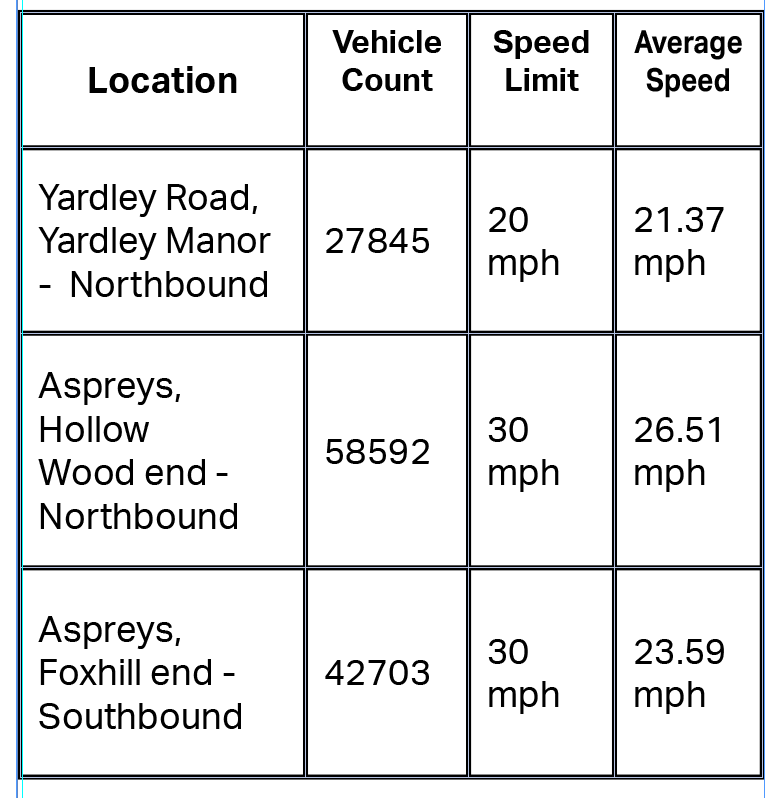
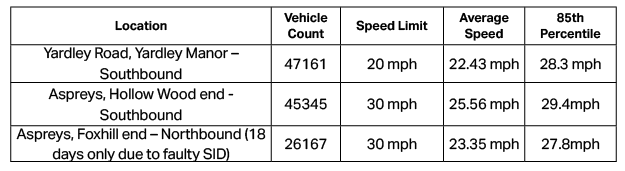
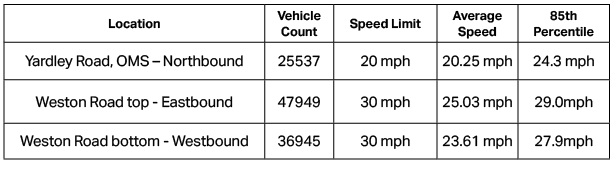
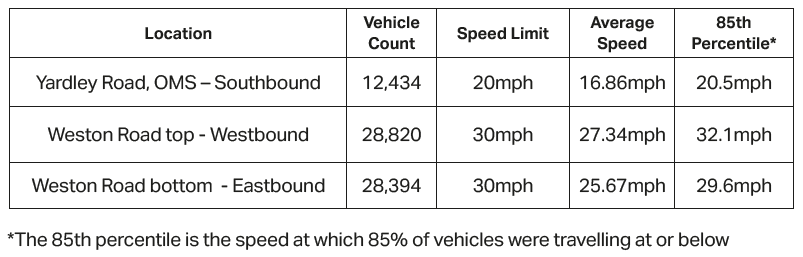
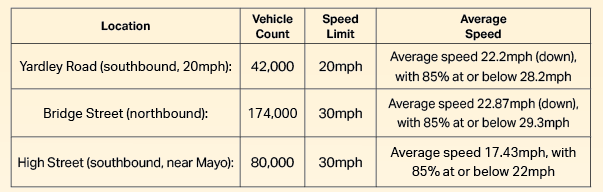
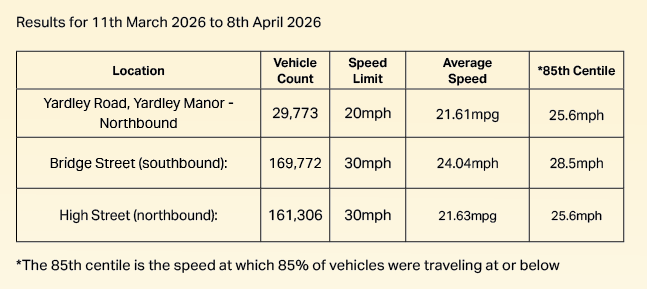
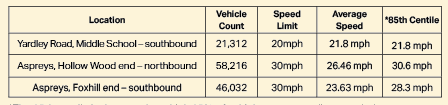
Deputy Clerk Rob Mungham presented two sets of Speed Indicator Device (SID) traffic data, covering key roads across shifting tracking periods:
June/July Data Set
Bridge Street (Northbound, 30mph): 262,045 vehicles; average speed 23.6 mph; 85th percentile at 29.7 mph.
High Street (Southbound, 30mph): 115,000 vehicles over 13 days; average speed 18.48 mph; 85th percentile at 23.3 mph.
Yardley Road, Yardley Manor (Northbound, 20mph): 36,208 vehicles; average speed 21.27 mph; 85th percentile at 25.1 mph.
July/August Data Set
Bridge Street (Southbound, 30mph): 184,000 vehicles; average speed 24.22 mph; 85th percentile at 28.8 mph.
High Street (Northbound, 30mph): 147,500 vehicles over 31 days; average speed 21.2 mph; 85th percentile at 25.4 mph.
Yardley Road, Yardley Manor (Southbound, 20mph): 52,500 vehicles; average speed 22.44 mph; 85th percentile at 28.4 mph.
The Mayor and Clerk concluded the exhaustive brief by noting that the clear traffic figures ultimately spoke
for themselves.
Tina Hobson is the new PCSO in the area and popped in the Phonebox office just before we went to print, she is keen to let people know
how to get in touch with her. Her number is 07779 586565. You can email her at
tina.hobson@thamesvalley.police.uk
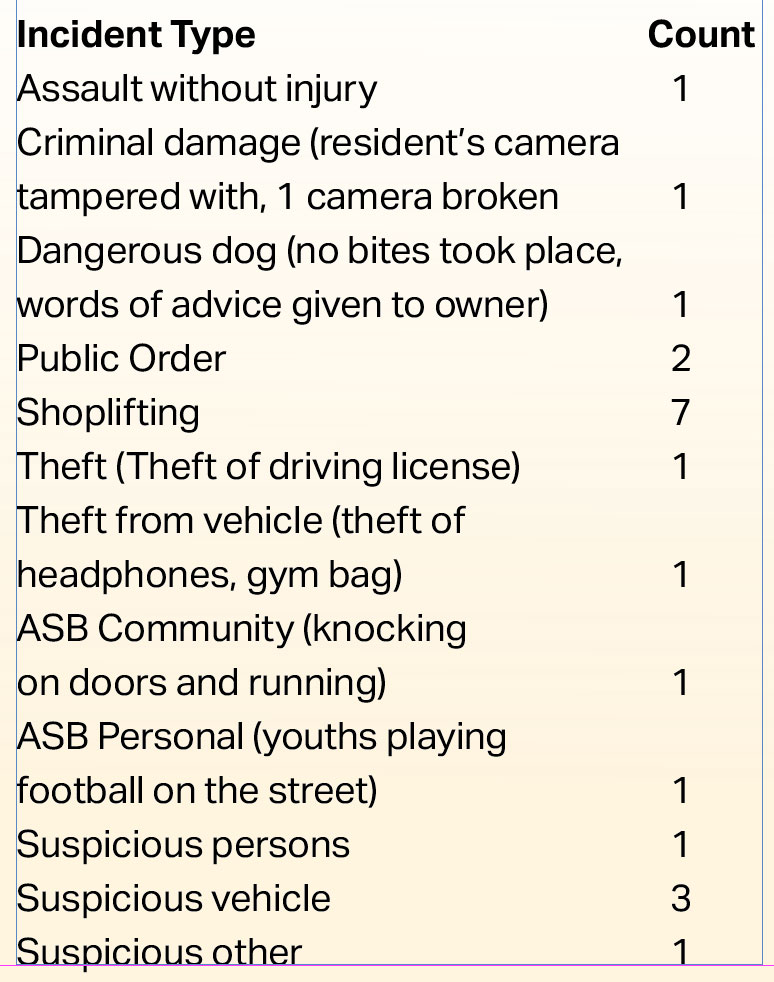
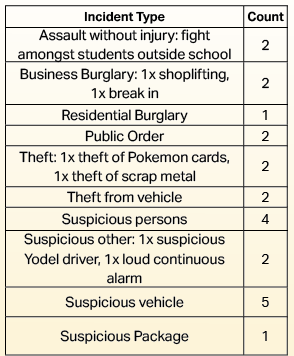
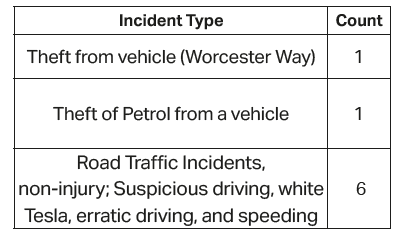
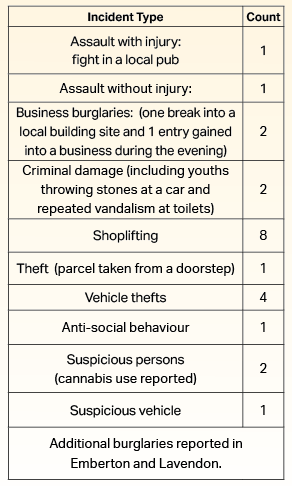
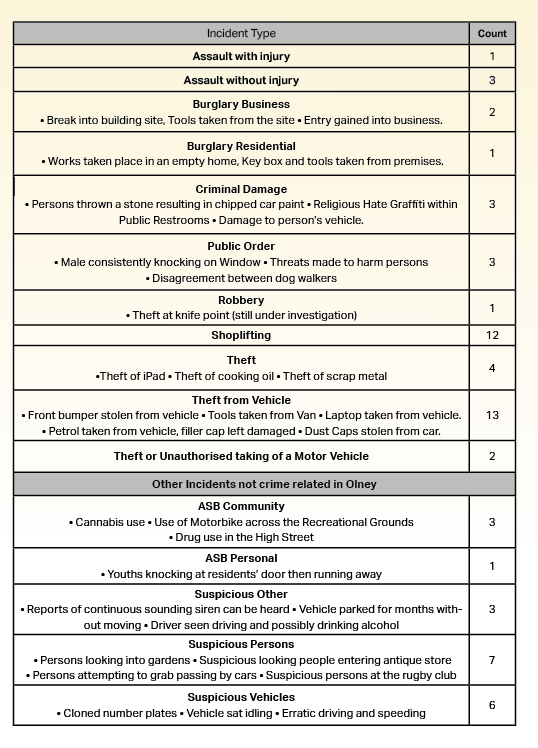
Thames Valley Police’s Rural Milton Keynes LPA team has released its latest localized policing statistics for Olney, covering the summer period from 5th July to 7th September 2026. Compiled by PCSO Tina Hobson, the report highlights that while Olney remains a statistically low-crime and peaceful area, local officers have been actively addressing an uptick in seasonal anti-social behaviour, opportunistic thefts, and minor road disruptions.
Key Developments and Quick Wins
The summer months saw swift action from local policing teams on the High Street, resulting in four arrests following a public order incident. In a testament to community vigilance, an attempted ‘Action Fraud’ scam was successfully thwarted. Scammers pressured a vulnerable local resident to withdraw large sums of cash, but alert bank staff intercepted the transaction, ensuring no money was lost.
However, the town experienced a rare high-profile property crime in early September when a commercial ram raid occurred at the local Tesco store. Investigations into this incident, along with a recent robbery and three separate dangerous dog encounters, remain actively ongoing.
Seasonal Recreation Ground Disruptions
The Olney Recreational Ground (The Rec) emerged as a focal point for anti-social behaviour over the warmer months. Police logs recorded 10 distinct nuisance incidents at the site, ranging from youths riding dirt bikes while wearing balaclavas, under age drinking, and littering, to aggressive verbal behaviour when residents asked individuals to clean up their rubbish. The local team is continuing to monitor the area closely to ensure the Rec remains safe and family-friendly as autumn arrives.
Theft, Vehicle Damage, and Road Incidents
Minor property and vehicle crimes made up a notable portion of the summer ledger. Incidents included a mobility scooter stolen from a shed, a purse snatching on the High Street, a mobile phone taken from a vehicle at Aldi, and a parcel theft from a residential doorstep. Car owners are also reminded to stay vigilant after three separate incidents of vehicle window and mirror smashing, with nothing targeted for theft.
On local roads, police handled three minor collisions – including two hit-and-runs in the Sainsbury’s and Market Place car parks – and issued formal warning letters to two motorists caught driving dangerously close to cyclists. Drivers were also strongly reminded to park considerately after an obstruction at the local fire station delayed emergency services responding to a call.
Get Involved: Upcoming Meetings
Thames Valley Police encourages residents to remain proactive by locking outbuildings, keeping car interiors clear of loose change, and reporting individuals seen scouting properties.
To discuss these statistics or raise specific neighbourhood concerns, residents are invited to meet directly with the Rural East policing team at three upcoming community forums:
• �Rural East Community Forum: Wednesday, 7th October 2026 at 7pm – The Pavilion, Lavendon.
• �Have Your Say Market Meeting: Sunday, 18th October 2026 from 4pm to 6pm – Market Place, Olney.
• �Have Your Say Afternoon Session: Thursday, 19th November 2026 from 2.30pm to 4.30pm – The Olney Centre, Olney.
With the traffic data settled, Mayor Debbie Whitworth steered the council toward the next Agenda Item:
Update on the Rec Community Centre and Paddle.
The Mayor invited the Clerk to share the latest news on the Recreation Ground, adding with a smile that everyone had already been notified of its completion and that a lovely open day was just around the corner.
The Clerk beamed as she shared heartening feedback from the community. The council had just received a wonderful email from a resident expressing deep gratitude for the new public toilets. The resident noted that previously, they always had to travel by car and rush home the moment their grandchildren needed to use the restroom; having these facilities available on-site was a massive relief. Jane then officially reminded the chamber that the grand opening date was set for 19th September. The Mayor warmly interjected, inviting any residents in the public gallery that evening to come along and celebrate.
The evening’s cooperative tone met with a wave of bureaucratic confusion as the meeting transitioned into:
Update on River
Councillor Bethune requested an update on the total costs incurred to date, which Clerk promised to bring to the finance committee or the next full council session. Turning to the pending ‘Padel’ project, a multi-speaker discussion revealed the council had intentionally paused the planning application until after 1st August. This strategic delay allowed the project to entirely bypass stringent, complex biodiversity net gain regulations, leaving it temporarily in limbo.
The debate grew complicated when a speaker questioned why a private Padel club was already registering its business name through planning at Hamptons House before council approval. The Clerk remarked bluntly that it would be a waste of the company’s time if the application failed. In contrast, Councillor David Chennells and others concluded it was simply a pre-emptive, high-risk business move to establish a corporate identity before advancing the process.
Seasonal Problems
Mayor Debbie Whitworth led the review and breathed a visible sigh of relief, emphasising with gratitude that these issues were, by definition, seasonal. Now that the summer months had drawn to a close, she noted that the council had officially reached the end of the seasonal problem period.
Reflecting on the summer, the Mayor walked the council through a list of clear wins for the community. On the practical side, the town had successfully added six new bins, emptied weekly, to manage the summer crowds.
Security had also shifted significantly, moving from a lack of oversight to a dedicated security firm actively patrolling during high-risk weekends and bank holidays. This physical presence was heavily backed by technology; newly installed CCTV systems had already proven their worth, directly allowing the Thames Valley Police to identify local perpetrators. Furthermore, significant marshalling efforts had been carried out over the weekends in alignment with the local Public Spaces Protection Order (PSPO), and all planned park signage had been fully installed.
The Mayor urged the chamber to broadcast these actionable victories to the community, stressing that residents should hear a message of proactive management rather than letting negativity dominate the narrative.
However, the summer had not been without its casualties. The Mayor addressed the darker side of public perception, revealing that due to highly negative media coverage during the year, both the ‘Spartan’ team and the primary security firm had chosen to sever ties and no longer wished to work for the council. While losing them was a blow, the Mayor remained optimistic, noting that a lovely new working group was already up and running to look for alternatives.
The focus then shifted to the future, with the Mayor laying out a clear directive: if they wanted to secure the town for the next wave of visitors, they needed to put a new security package in place. She requested that the working group gather competitive quotes to present at the next session, noting that the council had done all it could, and the next steps rested entirely on what the working group could bring to the table.
This call to action triggered a practical debate about the exact scope of the working group’s mission. Councillor Bethune stepped in to ask for clear guidance, questioning what exactly was expected of a security firm and whether guards were meant to spend their entire shifts physically stationed on the Recreation Ground. The Mayor clarified the timeline first, stating they were strictly looking at a seasonal framework – predominantly spanning from spring through to summer. Deirdre pushed back gently, emphasising the need for operational flexibility. The debate expanded as councillors chimed in, noting that the council previously didn’t have a clear idea of the required hours or specific time commitments.
Mayor Whitworth expanded the vision of the role, clarifying that a security contract would not mean guards were simply ‘stuck in the Rec.’ Instead, past security teams had provided comprehensive aid, including stepping onto the local Market Place to manage litter issues and overseeing general safety across the wider area. Realising the fine details of the contract were pulling the meeting off-course, the Mayor reigned in the discussion. She suggested that while the exact details were not on the current agenda, they could easily be brought back. She tasked the working group with going away to compile a structured proposal to replace Spartan, with the goal of returning to the council with concrete quotes in October.
From across the chamber, Councillor Diamandopoulos voiced her support for the plan but raised a vital concern about the lack of specific details. She warned that the directive felt a bit vague and needed to be ‘pinned down’ before the working group actually went to work. Without distinct parameters and explicit guidance on exactly what the council wanted, Christina argued, the working group would be left searching in the dark, wondering where they stood and what their boundaries were as they tried to move forward.
The meeting entered its final phase as Mayor Whitworth noted that it was brought forward purely for advice. She confirmed to the chamber that this year’s fireworks display was scheduled for Sunday, 1st November. The Mayor reassured everyone that it would feature the same setup as usual, and that everything was in hand to ensure a smooth event.
The Mayor noted that this issue frequently crops up in the town office and explained that a special request had been made that evening for the full council’s consideration. A lady had requested to purchase a burial plot in the local cemetery. Although she was not a current resident of the town, the Mayor explained that the applicant had a wealth of local history, with her entire family already buried there. Without revealing her identity, the Mayor proudly shared a fascinating piece of local trivia: the applicant’s mother was actually the historic winner of the very first International Pancake Race back in the 1950s. Given these strong historical ties to the town, the Mayor said she saw no major problem with the request and asked for the council’s agreement. A voice, presumably Councillor Prosser, quickly signalled her approval with a supportive ‘Yep, I agree,’ which the Mayor warmly acknowledged before moving forward.
This brought the focus back to administrative governance. Mayor Whitworth explained that she and Councillor Chennells had recently sat down with the Town Clerk to thoroughly review every single council contract stored in the office folders. She proudly announced that everything was entirely above board, perfectly in place, and checked off every compliance box, before turning the floor over to David to expand on the details.
Councillor Chennells stepped up to reassure the full council of their operational security, outlining how the town manages its network of partners. He explained that their external providers strictly fall into two distinct categories:
• Routine Suppliers: These are the standard, regular utility and service companies the council maintains formal contracts with.
• Ad-Hoc / Irregular Contractors: These are the local tradespeople called upon for reactive maintenance.
David clarified that the council does not necessarily draw up massive, formal contracts for these rapid-response repairs. Instead, the council uses a modern, agile approach: a formal letter of engagement sent via email. The office performs a routine check to ensure the contractor holds active public liability insurance, and the contractor replies via email to confirm the job. David defended this lean process, arguing that forcing a local business – which has reliably worked for the town for years – to submit a full commercial quote to replace perhaps a relatively small job would be an unnecessary layer of bureaucracy. Armed with this robust paper trail and secure emails, David concluded that every single supplier was accurately accounted for in the council’s electronic paperwork, ensuring complete transparency for the town.
With the council’s contracts verified, its heritage honoured, and winter events secure, the Mayor thanked the room, bringing a highly productive and diverse council session to a formal close.
The next meeting will be held on Monday 5th October at 7pm at the Olney Centre. If you would like to contribute to the Open Forum section at the start of the meeting, or any time the Mayor deems appropriate, please contact the Town Clerk:
townclerk @olneytowncouncil.gov.uk.
townclerk@olneytowncouncil.gov.uk.